Pierre by Nancy Southam
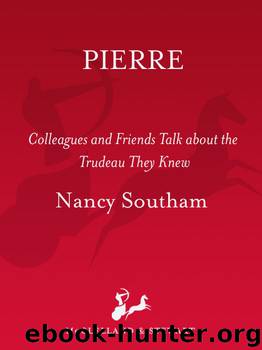
Author:Nancy Southam
Language: eng
Format: epub
ISBN: 9781551992013
Publisher: McClelland & Stewart
Published: 2008-12-24T16:00:00+00:00
MICHAEL KIRBY
Assistant principal secretary, 1974–76; secretary to the cabinet for federal-provincial relations, 1980–81; and deputy clerk of the Privy Council, 1981–82
The date: January 30, 1981. The time: 4 p.m. The location: the Prime Minister’s Office on the third floor in the southwest corner of the Centre Block. The issue for discussion at the meeting: Should the rights of aboriginal Canadians be entrenched in the Constitution, through the Charter of Rights and Freedoms?
The participants in the meeting: the prime minister; the minister of justice, Jean Chrétien; the secretary to the cabinet, Michael Pitfield; the deputy minister of justice, Roger Tassé and myself, secretary to the cabinet for federal-provincial relations.
The context: In January 1981, there was limited political support for the patriation of the Constitution and the inclusion of the Charter of Rights and Freedoms. Only the federal government, the federal Liberal caucus, and the Progressive Conservative governments of Bill Davis in Ontario and Richard Hatfield in New Brunswick were on side. Negotiations with the other eight provinces had broken off, and they had turned to the courts to block unilateral federal action.
At the same time, the federal government had been seeking to ensure the support of the British government, led by Margaret Thatcher, for a resolution of the Parliament of Canada to patriate the Constitution with a charter of rights, even if it was backed only by the federal government of Canada, and by New Brunswick and Ontario.
Mrs. Thatcher was personally committed to do whatever the Parliament of Canada requested. However, she was concerned that a significant number of British MPs would be likely to vote against the resolution, because they believed that it lacked support in Western Canada. This was because the federal Liberal caucus contained only two western members of Parliament. Mrs. Thatcher was not concerned about opposition from the Province of Quebec, because the federal Liberal caucus contained seventy-four of the seventy-five MPs from Quebec, which could be taken as an indication of political support for the resolution from the people of that province.
As a result of Mrs. Thatcher’s concern, in the late fall of 1980, I was asked by the prime minister to see if it would be possible to get the support of the federal NDP caucus. There were thirty-four NDP MPs: seven from Ontario, seven from Manitoba, seven from Saskatchewan, twelve from British Columbia, and one from the Northwest Territories. If the NDP caucus could be persuaded to support the resolution, it would bring on side twenty-seven western and northern MPs.
After protracted negotiations with the NDP leader, Ed Broadbent, and several members of his caucus, notably Ian Waddell and Nelson Riis, it was agreed that all but the Saskatchewan NDP MPs would support the resolution if–and only if–it included a clause entrenching Aboriginal rights in the Constitution. The Saskatchewan MPs would not back it in any case because of continued opposition from the premier of the province, Allan Blakeney.
The purpose of the meeting in the prime minister’s office was to decide if the federal government would agree to the negotiated deal.
Download
This site does not store any files on its server. We only index and link to content provided by other sites. Please contact the content providers to delete copyright contents if any and email us, we'll remove relevant links or contents immediately.
Waking Up in Heaven: A True Story of Brokenness, Heaven, and Life Again by McVea Crystal & Tresniowski Alex(37822)
Still Foolin’ ’Em by Billy Crystal(36367)
Cecilia; Or, Memoirs of an Heiress — Volume 1 by Fanny Burney(32569)
Cecilia; Or, Memoirs of an Heiress — Volume 2 by Fanny Burney(31968)
Cecilia; Or, Memoirs of an Heiress — Volume 3 by Fanny Burney(31948)
Fanny Burney by Claire Harman(26615)
Empire of the Sikhs by Patwant Singh(23093)
We're Going to Need More Wine by Gabrielle Union(19060)
Hans Sturm: A Soldier's Odyssey on the Eastern Front by Gordon Williamson(18604)
Plagued by Fire by Paul Hendrickson(17420)
Out of India by Michael Foss(16865)
All the Missing Girls by Megan Miranda(16077)
Cat's cradle by Kurt Vonnegut(15380)
Pimp by Iceberg Slim(14536)
For the Love of Europe by Rick Steves(14214)
Molly's Game by Molly Bloom(14153)
Bombshells: Glamour Girls of a Lifetime by Sullivan Steve(14087)
Leonardo da Vinci by Walter Isaacson(13351)
4 3 2 1: A Novel by Paul Auster(12418)
